







Listen to internet radio with MOVIE GEEKS UNITED on Blog Talk Radio
A Tale of Two Editors: Carol Littleton and Tim Squyres.
In January and February I hosted two events, each one honoring a remarkable film editor.
The first was with Carol Littleton, put on by UCLA Film and Television Archive at the Billy Wilder Theater. In our discussion we projected frame grabs of the actual cuts from “Body Heat,” recreating the analysis of her work from my book, The Invisible Cut: How Editors Make Movie Magic. A screening of that movie was followed by a Q & A with the audience. About a month later I staged a similar event with Tim Squyres at 92Y Tribeca, where he ran footage showing specific cuts, we deconstructed his work and screened “Gosford Park.”
My reason for doing this was to show and tell how an editor works, giving the audience a depth of understanding and appreciation for this final storyteller in the moviemaking process.
What I didn’t expect was the striking study in contrasts: of these two movies, their directors – and most of the all the editors.
First, the two movies and their directors:
“Body Heat,” made in 1981, is both a parody and tribute to the film noir genre. Writer and first-time director Lawrence Kasdan was very particular about staying true to the arch, noirish dialog, and he made it clear to his actors, in rehearsal, that this was not to be tampered with. The plotting was also very complex and the dénouement and had to be delicately adhered to. He also was careful in creating a balance between explicit and implicit sexuality, and because of that was absolutely set on hiring a female editor.
“Gosford Park,” made in 2001, takes place at an English country estate in 1932 and was directed by the iconoclastic director Robert Altman. His intention was to upend convention. He didn’t really care that much about the Agatha Christie-type murder plot; he was more interested in examining behavior among the English upper and servant classes. He also liked to improvise from the screenplay in rehearsal so that the actors could discover ‘the truth’ in the scene. What intrigued him in his films were ‘the errors.’
Now, the two editors:
Carol Littleton was originally going to be a professional musician and is very much in tune with the musicality of language in a movie. She was particularly keyed in to the hyper-stylized and seductive dialog in “Body Heat.” Carol also said she hears music in the rhythm and movement of the imagery when she cuts; and although it is hard to describe something as visual and instinctual as editing, there is something distinctly musical about her work. As is true of all editors, she also has the discipline of a musician. And even though she has for many years edited on a computer, she still approaches the footage very much the same way she did when she was cutting film, which is to do one version of the entire first cut. She may try many variations in certain parts of the movie, but she will always keep that original version as her basis. Her female sensibility had a particular impact on “Body Heat;” she showed that the evocative power of one’s imagination is sexier than a lot of graphic nudity. She was also able to internalize the emotions of the femme fatale for the women in the audience, which is unusual for film noir. There was a problem when they were shooting the turning-point scene we ran and deconstructed from that movie. Much of the original footage was unusable and as a result Carol had to intercut three points of view, two of which were re-shoots. In fact, the tension that Carol created using eye contact and dynamic movement actually made the scene what it was, a powerful erotic high point of the movie. But that is, after all, an elemental to the editor’s job, making the most out of the compromises that inevitably happen during the shooting of a movie.
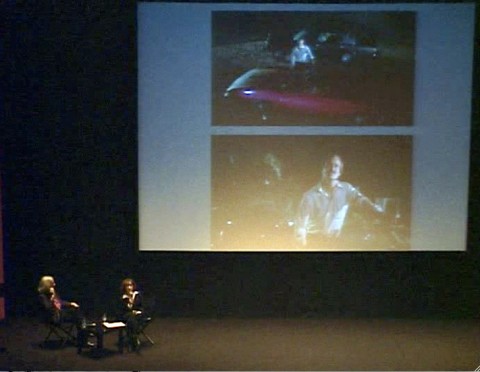
Carol and I looking at frame grabs of her cuts from “Body Heat”
Tim Squyres comes from a family of scientists and was going to be an astronomer himself. And in a sense his background informs his work. He has the sensibility of an artist but also has a uniquely meticulous, methodical way of approaching the almost unlimited possibilities that are presented to an editor. He will cut several preliminary versions before he even starts to cut the version that he will show to the director: first a version all in close-ups, then one all in medium shots, etc, basically a version for each angle. He will not rest until he exercises all the possibilities. But when he first ran some of the initial dailies of “Gosford Park” he thought he was going lose his mind. In fact the talk on the set was ‘What’s the editor going to do with this?’ And that’s because, with only 55 days to shoot 59 actors – many in group scenes – Altman knew he couldn’t cover the scenes in a traditional manner. Instead he usually had two cameras dolly or pan among the actors, always moving whether they were motivated or not – and no two takes were ever the same. So Tim adjusted his method, still creating several versions, but in this case using sections of footage rather than angles. As a result he often had to make mismatched pieces fit together, and he showed us some of the ways he used sleight of hand to keep the audience from noticing. We also saw that – because he made himself cut all those versions – he was able to unearth many gems, those surprising, happy accidents that take place on an Altman set.
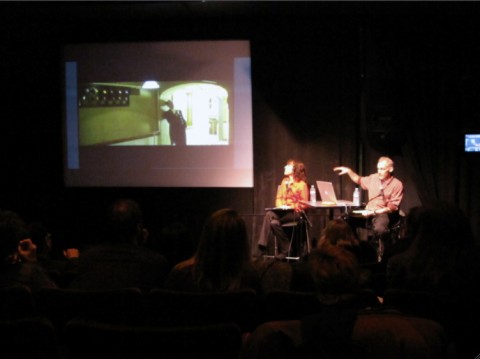
Tim and I looking at footage of his cuts from “Gosford Park”
And in both of the movies, the directors were smart enough to leave the editors alone when they put the movie in a first cut and overall had a give-and-take working relationship that, at its best, resembles a good marriage. In Carol’s case, her work on “Body Heat” was the beginning of a 29-year friendship and working relationship with Lawrence Kasdan. And Robert Altman called Tim’s work on “Gosford Park” ‘flawless.’ Can’t get much better than that.
Last but not least I want to mention the two editors’ similarities, since it unravels some of the mystery behind their successes. They’re both passionate about what they do, which was so evident at these events when they explained their process before the screening; and then – after viewing those glorious 35mm prints years in front of a very receptive audience – were energized enough to field Q &A’s late into the night. What was also apparent is that they both have a certain calm, wisdom, and sense of humor necessary to negotiate a world that can be full of insecurities and political minefields. They are grounded by confidence; but they’re also humble in their quest to honor the director’s vision and have the clear-eyed knowledge that what matters most is making the movie the best it can possibly be.
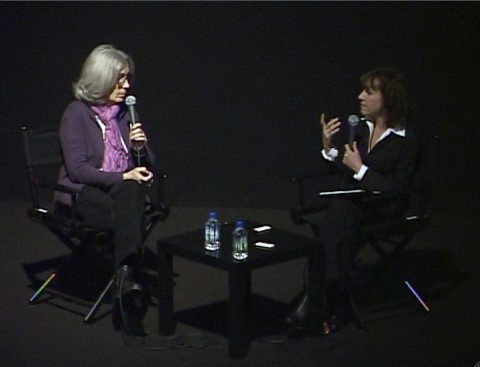
In discussion with Carol at the Billy Wilder Theater
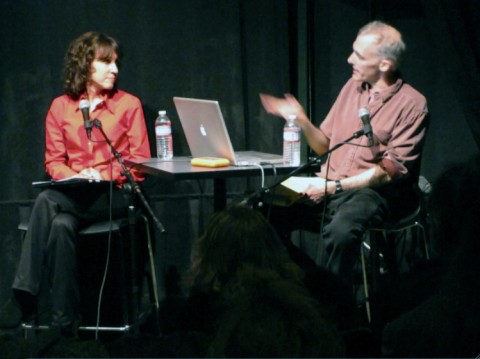
Talking to Tim at 92 Y Tribeca
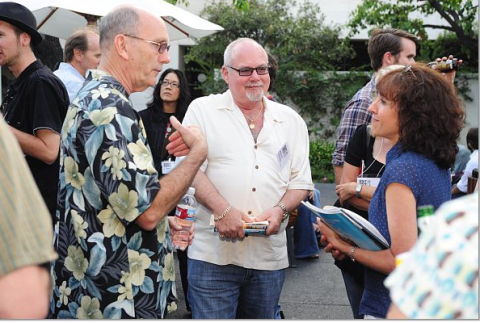
Talking shop with editor Joel Cox and A.C.E. President Randy Roberts
Two months after moderating a panel at EditFest NY, I did the same for EditFest LA, which took place on the Universal Studios lot.
Randy Roberts, the president of A.C.E. (American Cinema Editors), was once again a genial host giving the audience – mostly composed of aspiring editors – sound career advice. Example being: “Leave your ego at the door.”
The topic of discussion for my panel was again “Small Screen, Big Picture: Editing Television” and my panelists were all really interesting and different, both in personality and work experience.
Malcolm Jamieson, who was originally an artist, was very passionate when he talked about the art of editing, and in the clip he showed from Mad Men he explained how he achieved an important and poignant moment between two characters. David Rogers showed a hilarious clip from The Office, which showed how he was able to sequence – with dizzying swish pans and multiple points of view – the best performances and reactions. Karen Stern showed a clip from Law & Order: SVU with Robin Williams, where she was able to create and sustain the riveting intensity of the scene. Chris Willingham showed a clip from 24 and spoke about the challenges of editing in real time, and not being able to use cutaways and other time-jumping devices that editors usually rely upon. His wife, Lynne Willingham, showed a clip from Breaking Bad (for which she just won her second Emmy) and spoke compassionately about how difficult it is for some of the directors on this series – who are often from indie film backgrounds – to adjust to working in a producer-controlled medium.
I had great conversations with two very different and fascinating feature film editors as well. Brent White (who edits the movies Judd Apatow directs and the two he produced with Adam McKay directing) comes from a background one might not expect – he’s a Mormon from Utah. On the other hand it’s not really surprising that this family man with a positive personality would be the right choice. After all, there is a warm, relationship-oriented sensibility underlying the outrageous bad boy/dark humor in Apatow’s work. These movies shoot a ton of footage and much of it is improvised, so his editor also has to have a lot of patience and insight to find the gold in them thar hills. Example: the high-point scene in McKay’s Talladega Nights was written in the screenplay as just a dinner table scene with product placement.’ They let the cameras roll for two days straight!
Joel Cox is Clint Eastwood’s editor and has the same macho, no-nonsense strength about him as his director. He told me that my husband Sam O’Steen, who he had known when they were both apprentices at Warner Brothers, influenced him in two ways. He was inspired by Sam’s resolve to wait for that break into feature films no matter how long it took. (It took Sam 18 years: 10 years in Warner’s print shop and 8 years assisting, finally becoming an editor on Youngblood Hawke.) Sam also never looked at anything he cut until he ran it for the director. The lack of second guessing, is very compatible with Eastwood’s style of shooting, since he rarely shoots multiple takes and is very clear about what he wants before he starts filming.
All told it was an inspiring weekend. And editors are funny, they are not by nature talkers, and often seem mortified at the idea of getting up and speaking. But once they get started – boy, can they talk!
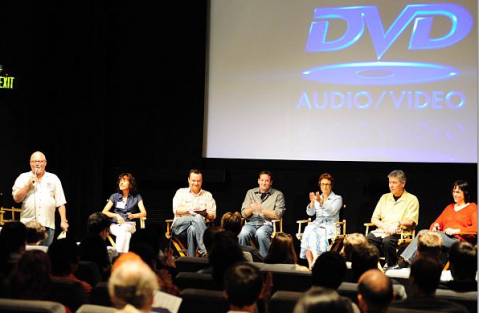
My panel: Malcolm Jamieson, David Rogers, Karen Stern, Chris Willingham and Lynne Willingham
EditFest LA was launched with great success last year by ACE (American Cinema Editors) – the honorary guild for editors – and this year they decided to have EditFest NY on June 12th and 13th at the Directors Guild Theater. This was the first event of its kind: two incredible days of panel discussions where many of the most respected and well-known editors analyzed their work and careers for an eager audience of up-and-coming filmmakers.
I moderated a panel called “Small Screen, Big Picture: Editing Television” and my panelists included Michael Berenbaum (Sex and the City, Nurse Jackie), Ken Eluto (30 Rock, Oz), Alex Hall (The Wire, The Unusuals), Meg Reticker (30 Rock, Big Love) and Kate Sanford (The Wire, Kings)
What I found unique about ‘my’ New Yorkers, having worked and lived among editors from both coasts, was a true intimacy among them, probably because New York has a smaller industry and the geography of the city is more compact. And because there are fewer jobs, New York editors end up not being pigeon-holed; at any point in time they may be working on a documentary, an indie feature, or a TV show. Considering how small the job pool is and how often they worked on the same TV series, you’d think they would be especially competitive but I found just the opposite. They were very supportive of one another.
My panelists started off by telling amusing and insightful stories about how they got their breaks; they also talked about the difference between cutting comedy and drama (there really isn’t any), the difference in whom they have to answer to (in television it’s the producer, in features it’s the director). When I asked them what they wish someone had told them when they were starting out, the truth is that, although talent is necessary, passion – and compassion – are essential ingredients for success.
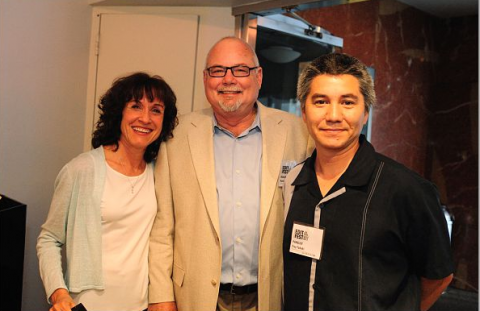
With ACE president Randy Roberts and panelist/editor Troy Takaki.
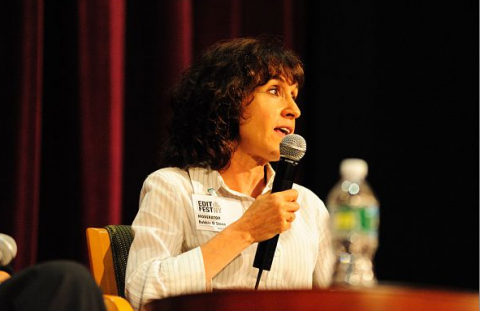
Moderating the panel
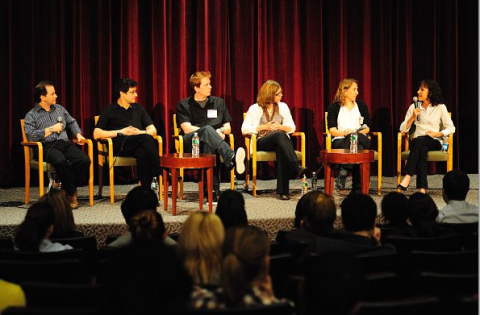
My panel: Michael Berenbaum, Ken Eluto, Alex Hall, Meg Reticker and Kate Sanford
Photos by Tilt Photo.
This scene from Modern Romance – where the film editor (Albert Brooks) is cutting a cheesy sci fi flick – is not only painfully funny but realistically captures what can happen in the cutting room. First we see that Bruno Kirby, who plays Albert Brooks’ assistant, is eager to get credit for a cut he made, which Brooks complements him on – what a nice boss! Then the director (played by the real-life director James Brooks) comes in with a stupid idea, a sound effect that doesn’t matter, and although the editor initially fights it, he gives in to the director’s incessant demand. Worse still, we had just seen the editor make a change that really helps the movie. He took out a line an actor says to avoid revealing a crucial piece of information too early on. When he shows this change to the director, he’s not happy because he likes the next actor’s (George Kennedy’s) reaction to that line. The editor explains that keeping the first actor’s line in, tips the audience off, but it’s more important to the director to keep Kennedy’s precious line. He’s ignoring a very important piece of advice I give in The Invisible Cut: “Movie first, scene second, moment third.” That should be the order of importance whenever an editing decision is made. The director, in this scene, is holding onto a moment he likes rather than seeing the overall movie and how important it is to set up mystery and suspense in the story. When the editor caves in for the second time to the director’s misguided judgment, we experience the frustrating compromises that are often made in the cutting room.
This is also the only movie that I know of where a film editor is the romantic lead. Does anyone know of any other? I would like to know!
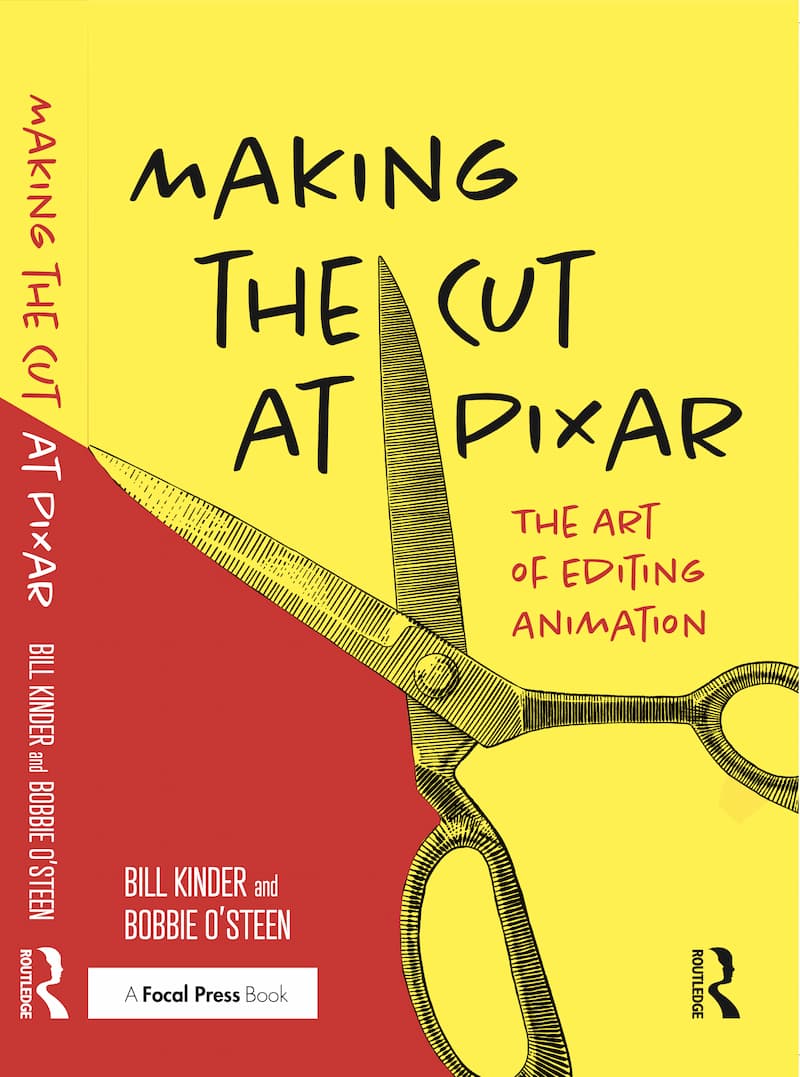
With unprecedented access to the Pixar edit suite, this authoritative project highlights the central role film editors play in some of the most critically acclaimed and commercially successful movies of all time. Exclusive interviews with animation editors and other creative leads are supported by footage from deep inside Pixar’s vault. Nearly 90 minutes of video segments include never-before-seen works in progress, deleted scenes, and demonstrations to shed light on how these beloved stories are crafted. The challenges and essential contributions of editors in animation have never been examined in such depth and detail.
View Bobbie's author page at Amazon »
This book shows how the mysterious art of film editing is actually done, by using the "out" and "in" frames of the actual cuts from classic movie scenes – namely The Graduate, Chinatown, Rear Window, The French Connection, Butch Cassidy & the Sundance Kid, The Big Chill, A Hard Day's Night and Body Heat…
The Invisible Cut available at Amazon.com. Click here »
Legendary film editor Sam O’Steen (The Graduate, Chinatown) talks candidly with wife Bobbie O’Steen about his work in the cutting room and behind the scenes on some of the most influential movies in motion picture history. … Read More »
Cut to the Chase available at Amazon.com. Click here »
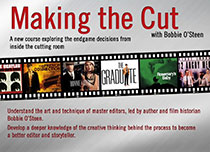
Bobbie's new course at Manhattan Edit Workshop explores the art and technique of master editors and their endgame decisions from inside the cutting room. Read More >